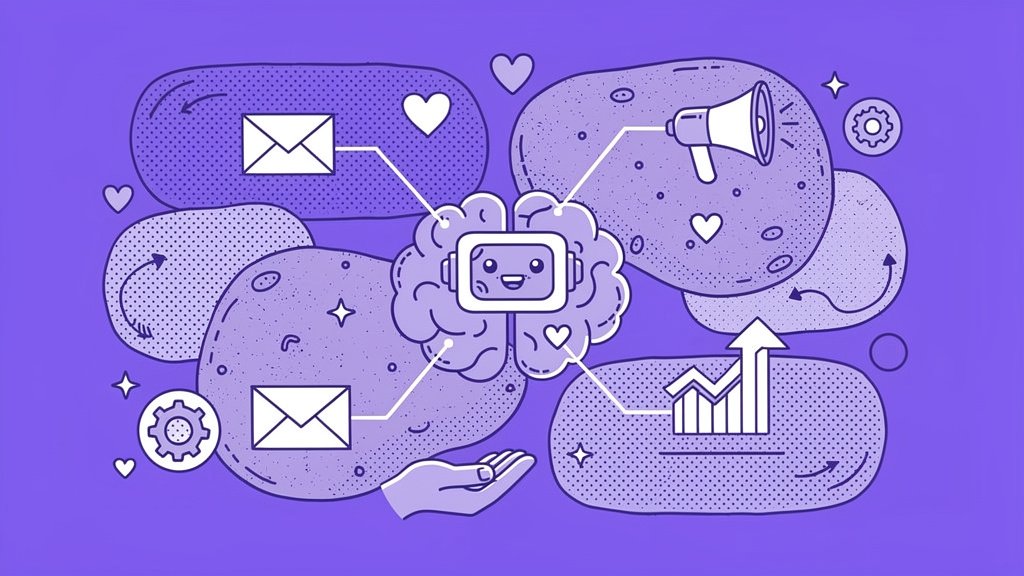
Small nonprofits live in a constant state of doing more with less—tighter budgets, smaller teams, missions that never sleep. Meanwhile, donor expectations keep rising and the competition for attention grows fiercer. Traditional marketing demands resources you simply don’t have. That’s where artificial intelligence and marketing automation come in, fundamentally changing how small NGOs connect with donors, volunteers, and supporters. The real question? It’s not whether you can afford AI-powered marketing automation—it’s whether you can afford to skip it.
The AI Adoption Moment for Nonprofits
Nonprofits are embracing AI faster than ever. According to 2025 benchmark data, 71% are using or planning to use AI for fundraising and event planning—a remarkable 28-point jump from previous years (Daxko, 2025). The same percentage explores AI for copywriting, while 49% integrate it into donor management (Daxko, 2025). Perhaps most striking: 89% of purpose-led organizations now actively use some form of AI (NonProfit PRO, 2025).
But here’s where it gets interesting. Larger nonprofits (budgets over $1 million) adopt AI tools at nearly twice the rate of smaller organizations—66% versus 34%. Yet when smaller nonprofits access affordable solutions like ChatGPT, their teams dive in headfirst. In fact, 82% of employees at nonprofits with budgets under $100,000 use AI tools regularly (NonProfit PRO, 2025). Translation: when the barrier to entry drops, small nonprofits embrace these technologies enthusiastically.
The Real Challenge: From Adoption to Strategy
Adoption rates only reveal part of the picture. While 85.6% of nonprofits explore AI tools, just 24% have a formal implementation strategy (NonProfit PRO, 2025). Nearly half (43%) rely on only 1–2 staff members to handle IT or AI decisions, creating bottlenecks that prevent growth. For small NGOs, this gap between curiosity and capability represents both hurdle and opportunity—develop a clear AI strategy now, and you’ll gain competitive advantage.
Protip: Before investing in AI tools, map your biggest pain points. Are volunteers spending hours on email follow-ups? Is grant writing bottlenecking your fundraising? Start small by automating one high-impact task, measure the results over 60 days, then expand. This phased approach reduces costs and builds internal confidence.
What AI-Powered Marketing Automation Actually Does
Marketing automation isn’t magic—it’s systematized intelligence applied to repetitive tasks. For small NGOs, it handles the work that drains limited staff bandwidth while maintaining the personalization donors expect.
Core Applications Transforming Nonprofit Marketing
| Application | How It Helps Small NGOs | Impact |
|---|---|---|
| Personalized Email Sequences | Automatically sends targeted thank-you notes, event reminders, and giving appeals based on donor history and behavior | Increases engagement without manual effort |
| Donor Segmentation | AI analyzes donor data to group supporters by giving patterns, interests, and capacity | Enables hyper-targeted messaging at scale |
| Predictive Analytics | Identifies which donors are most likely to give again, upgrade their gift, or lapse | Allows strategic allocation of outreach resources |
| Content Creation Assistance | AI tools draft grant proposals, email appeals, social media posts, and donor communications | Reduces writing time by 50%+ |
| Chatbot Engagement | 24/7 automated responses to common donor and volunteer questions | Improves response time without adding headcount |
| SMS and Social Automation | Schedules messages, automates birthday/anniversary donor outreach | Drives higher engagement rates than email alone |
With 58% of nonprofits already integrating AI into communication strategies (Averi AI, 2025), these tools are rapidly becoming standard practice rather than competitive edge.
The Measurable Outcomes
Beyond operational efficiency, AI-powered automation drives real fundraising results:
- increased donation conversion rates through optimized ask amounts and personalized appeals,
- improved donor retention via consistent, automated touchpoints that scale without burnout,
- reduced grant writing time, with AI potentially increasing approval rates by up to 25% when used effectively (Averi AI, 2025),
- 3X increase in monthly donor retention at organizations using integrated automation platforms (Knox Community Foundation, 2025).
For small NGOs operating on tight margins, these improvements translate directly to mission impact.
Protip: Audit your current tech stack before adding new tools. Often, the software you already use has automation features you haven’t discovered. Many email platforms, donation processors, and volunteer management systems include basic workflow automation. Activate those first—it’s free and requires only 2–3 hours of configuration.
Real AI-Powered Use Cases for Small NGOs
Use Case 1: The Automated Donor Engagement Funnel
A small animal rescue receives 30 new donors monthly. Manually sending personalized welcome sequences, thank-you emails, and event invites consumes 4–5 hours weekly for one staff member.
The AI Solution: Set up automated email sequences triggered by donation amount. First-time donors under $50 receive a thank-you, mission impact story, and volunteer opportunity. Those giving $50+ get a personalized note from the executive director, an impact report, and major gift cultivation email. All donors receive monthly updates, automatically segmented by giving history.
Result: Same personalization, zero additional staff time. That team member reallocates 4 hours weekly to major donor conversations and partnership development.
Use Case 2: Content Creation at Scale
A youth mentoring nonprofit struggles to maintain active social media across Instagram, TikTok, and LinkedIn. Their part-time marketing volunteer burns out creating 15+ posts monthly.
The AI Solution: Use ChatGPT or Claude to draft 4 weeks of social content at once, customized by platform. Generate branded graphics in Canva AI’s design templates (2–3 minutes per post). Schedule everything using Buffer or Later.
Result: 8 hours of monthly creative work reduced to 2 hours. Posting consistency increases; volunteer stays engaged.
Use Case 3: Grant Writing Acceleration
A small education nonprofit targets 5 grants annually, each requiring 15–20 hours of proposal writing. This pulls resources from program delivery.
The AI Solution: Use ChatGPT to draft initial proposal sections based on grant guidelines. Apply specialized AI tools for nonprofit-specific language and formatting. Staff refines and personalizes AI drafts in 5–7 hours instead of 15–20.
Result: Same number of grants submitted with 40–50% less staff time invested. Approval rate improves through more polished submissions.
Protip: When selecting automation platforms, prioritize integration breadth. A platform that natively connects your donation forms, email marketing, CRM, and SMS messaging creates 10X more value than best-of-breed tools requiring technical glue. For small teams with limited IT support, unified platforms are force multipliers.
Try This: Your AI Marketing Automation Starter Prompt
Ready to start automating your marketing? Copy and paste this prompt into ChatGPT, Gemini, or Perplexity—or try it in one of our custom tools or calculators built specifically for nonprofits:
Create a 4-week automated email nurture sequence for [NONPROFIT NAME] that engages new donors who gave [DONATION AMOUNT]. Our mission focuses on [MISSION DESCRIPTION]. Each email should be approximately [WORD COUNT] words and include a clear call-to-action. The sequence should build connection, demonstrate impact, and move donors toward becoming monthly recurring supporters.

Variables to customize:
1. [NONPROFIT NAME] - Your organization's name
2. [DONATION AMOUNT] - e.g., "$25-50" or "their first gift"
3. [MISSION DESCRIPTION] - Brief 1-sentence description of what you do
4. [WORD COUNT] - e.g., "150-200" for concise emails
This prompt gives you a foundation for donor engagement automation in minutes. Refine the AI output with your organization’s voice, add specific impact stories, then load the sequence into your email platform.
Overcoming Small NGO Barriers to AI Implementation
Small nonprofits face predictable obstacles when implementing AI marketing automation. Understanding these barriers—and how to navigate them—accelerates successful adoption.
Barrier 1: Lack of In-House Expertise
The Problem: 60% of nonprofits lack in-house expertise to assess AI tools effectively, and only 4% have AI-specific training budgets (NPTechforGood, 2026). Small organizations rarely employ dedicated marketing technologists.
The Solution: Leverage vendor support—most nonprofit-focused platforms include training webinars, documentation, and support calls. Use free resources from Google.org, TechSoup, and nonprofit industry associations. Start with beginner-friendly tools like ChatGPT and Canva that require minimal technical knowledge. Join peer learning groups through organizations like NTEN or local nonprofit tech meet-ups to connect with peers navigating the same challenges.
Barrier 2: Data Privacy and Security Concerns
The Problem: 70% of nonprofit professionals worry about data privacy, 63% question AI accuracy, and 57% are concerned about representation biases in AI systems (NPTechforGood, 2026).
The Solution: Choose nonprofit-focused vendors committed to data protection. Implement basic data governance—know what donor data you’re sharing with each tool. Test AI outputs before using them in donor-facing communications (AI tools make mistakes, so always have humans review before sending). Document AI usage: 76% of nonprofits lack an AI policy (NPTechforGood, 2026), creating risk exposure. Develop a simple AI use policy outlining what tools you use, why, and how you maintain data security.
Protip: Calculate ROI by time, not just money. If AI saves one staff member 5 hours weekly, that’s 260 hours annually—equivalent to 6.5 work weeks. What’s the value of reallocating 6+ weeks to fundraising, program delivery, or donor relationships?
Barrier 3: Budget Constraints
The Problem: Nonprofits allocate only 5–15% of total budget to marketing (Big Sea, 2025). When overhead is tight, technology investment feels like luxury.
The Solution: Start free. ChatGPT (free tier), Mailchimp (free nonprofit account), Canva (free+nonprofit discounts), and many platforms offer free nonprofit tiers requiring zero cash outlay. Test before scaling—pilot one automation workflow for 60 days. Measure time saved, donor response rates, conversion metrics. This data justifies investment in additional tools or premium tiers. Look for integrated solutions that consolidate donor management, email automation, campaign execution, and analytics into one system—eliminating multiple subscription costs and integration complexity.
How Funraise Powers AI Marketing Automation for Small NGOs
Funraise exemplifies how modern platforms serve small nonprofits specifically. Rather than forcing nonprofits into business-oriented workflows, it builds automation around donor behavior, giving cycles, and mission impact.
Key features include:
- behavior-triggered email sequences that automatically nurture donors based on donation history, engagement, and giving patterns,
- customizable donation forms with AI-optimized ask amounts increase conversion rates,
- dynamic donor segmentation allows hyper-targeted outreach without manual data work,
- integrated SMS messaging enables high-engagement text campaigns automated by donor actions,
- custom reporting and AI forecasting surfaces predictive insights about donor lifetime value and retention risk.
By consolidating these functions into one platform, Funraise eliminates the integration complexity that slows small team adoption. Organizations using integrated platforms report improved donor retention, increased online donations, and 3X growth in monthly recurring giving (Knox Community Foundation, 2025).
The best part? Funraise offers a free tier so you can start automating today—no commitments, no credit card required. For small NGOs testing AI-powered automation for the first time, this risk-free entry point removes the biggest barrier to getting started.
The Path Forward: Strategic Implementation in 2025 and Beyond
The nonprofit sector has reached an inflection point. AI adoption is no longer aspirational—it’s operational necessity. Yet the implementation gap persists: 89% of nonprofits use AI, but only 24% have strategies to scale it (NonProfit PRO, 2025).
For small NGOs, the path forward centers on three principles:
1. Start with Donor and Volunteer Engagement. These are highest-impact areas for small teams. Automated welcome sequences, thank-you workflows, and event reminders directly improve retention without requiring sophisticated marketing expertise.
2. Measure Everything. Before and after implementing automation, track staff hours spent on specific tasks, donor engagement metrics (open rates, click-through, response rates), campaign conversion rates, and volunteer recruitment efficiency. This data justifies expanded investment and guides next-step implementation.
3. Build Organizational Capability, Not Just Tool Adoption. Train 2–3 staff members to own automation tools. Document workflows. Create simple operating guides. When people leave, your systems remain operational.
Nearly half of nonprofit leaders (47%) believe AI will significantly boost their organization’s productivity (NonProfit PRO, 2025). That optimism is warranted—but only for organizations that move from exploration to execution.
The small NGOs winning with AI today aren’t the ones with the biggest budgets or largest teams. They’re the ones asking clear questions: Where does AI remove burden from my team? How does it deepen donor relationships? What can we measure to prove impact? Then they start small, learn fast, and scale sustainably—often beginning with free tools like Funraise that let them test, refine, and grow without financial risk.
AI-Assisted Donor Research: How to Work Smarter in 2026
Nonprofit leaders know the struggle: finding major donors with a skeleton crew while expectations keep climbing. Maybe you're buried in spreadsheets, following hunches about potential givers, watching opportunities slip through the cracks. Sound familiar? Here's the thing—AI transforms donor research from tedious manual labor into sharp, scalable intelligence. You'll reach the right people with better…

Proving the ROI of Your Nonprofit Marketing Efforts to Sceptical Stakeholders
Nonprofit leaders know this scenario all too well: you've just wrapped up a successful campaign, but when you present the results to your board, you're met with raised eyebrows and pointed questions. "Is our marketing spend really worth it?" Proving marketing ROI transforms skepticism into support by connecting every dollar spent to measurable mission impact.…

A Data-Driven Fundraising Look at Why People Choose One Mission Over Another
A Data-Driven Fundraising Look at Why People Choose One Mission Over Another With over 1.5 million nonprofits vying for donor dollars, figuring out why someone chooses your mission over another isn't just helpful—it's survival. The answer doesn't come from guesswork. It emerges from data revealing how emotions, values, and tangible proof shape donor decisions. What…