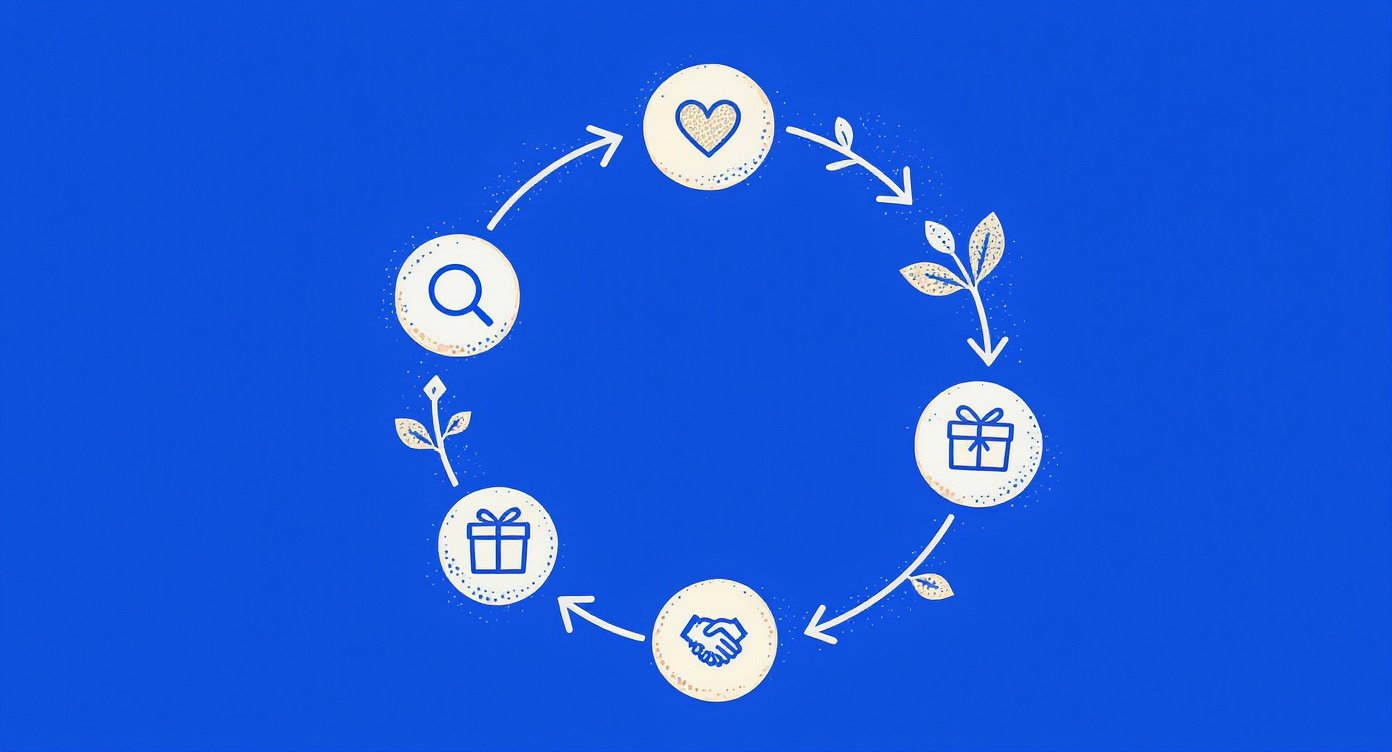
Here’s the reality: Only 18–20% of first-time donors ever give again (Association of Fundraising Professionals). But there’s a silver lining—when someone makes that second gift (what we call the “golden donation”), their likelihood of giving again jumps to approximately 60% (Nonprofit Hub). This dramatic shift shows why understanding the donor cycle is critical for your nonprofit’s sustainability.
If you’re running a small nonprofit team with endless priorities, the donor cycle offers a proven framework for turning one-time supporters into loyal, lifelong partners. Let’s explore how to execute each stage effectively.
Understanding the Donor Cycle Framework
Think of the donor cycle as the complete relationship journey a supporter takes with your organization—from first learning about you through sustained partnership. Instead of viewing donors as transaction points, this framework focuses on continuous relationship-building.
Most effective models break down into three primary stages:
- Donor Acquisition: identifying, engaging, and welcoming new prospects,
- Donor Retention: keeping supporters engaged to prevent them from lapsing,
- Donor Upgrade: cultivating relationships to inspire recurring or major gifts.
Since acquiring new supporters costs significantly more than retaining existing ones, investing heavily in retention during the early stages pays dividends for years. This understanding should fundamentally shape where your lean team focuses energy.
Stage One: Acquisition That Sets Up Long-Term Success
The mistake most nonprofits make: focusing solely on securing the gift without setting up long-term engagement. The most effective approach begins cultivating before the ask.
During acquisition, your mission must inspire emotional connection. Position your cause as both urgent and solvable, giving potential supporters a reason to take action while subtly emphasizing the importance of continued involvement. This primes first-time givers to consider recurring options during checkout.
Here’s a powerful stat: organizations using data-informed strategies achieve a 12% higher year-over-year donor retention rate compared to those operating without analytics (Sisense). Even your acquisition messaging should be informed by what you know about your most loyal supporters.
Technical optimization matters immensely. Over 50% of web traffic now comes from mobile devices (Funraise), and nonprofits using optimized donation technology experience a 50% conversion rate on donation forms (Funraise)—proving that technical excellence directly impacts first-touch success.
Protip: Map your current supporters against the three cycle stages. You’ll likely discover your largest untapped opportunity sits in retention—people who gave once but never returned. Focus here before expanding acquisition efforts.
The Critical First 90 Days: Make or Break
The 90 days following a first gift determine whether you build momentum or lose the relationship entirely. This window requires strategic, consistent touchpoints that demonstrate impact and build connection.
Your 90-Day Stewardship Blueprint
Immediate Thank You (Same Day): Acknowledge and celebrate their support via email and personalized note. Make it genuine—ditch the generic templates.
Impact Connection (Week 1–2): Show exactly how their gift creates change. Use specific stories, not broad generalizations about serving “hundreds of families.”
Donor Profile Survey (Week 3–4): Ask about communication preferences and motivations. Honoring these preferences signals respect and dramatically improves retention.
Impact Update (Week 6–8): Demonstrate ongoing progress through newsletter content or dedicated email series to keep your nonprofit top-of-mind.
Soft Re-engagement (Week 12): Invite further involvement before making another ask—volunteering, attending an event, or joining a community call.
The “golden donation” moment arrives around day 90–120 when you strategically re-solicit. But here’s the key: only re-engage after you’ve genuinely demonstrated impact. Consider sending a video message celebrating their support milestone before formally asking for a second gift.
One organization achieved 98% donor retention by prioritizing this early engagement period and emphasizing monthly giving from the start (Funraise Podcast). Their success didn’t come from complex tactics—it came from consistent, authentic storytelling and genuine relationship-building.
AI Prompt: Create Your Personalized Donor Journey
Ready to design your nonprofit’s donor cycle strategy? Copy and paste this prompt into ChatGPT, Gemini, or Perplexity—or use our custom tools and calculators for even more specialized nonprofit planning:
Create a 90-day donor stewardship plan for my nonprofit with the following details:

Organization mission: [DESCRIBE YOUR CAUSE]
Average first-time gift amount: [DOLLAR AMOUNT]
Current team capacity: [NUMBER OF STAFF/VOLUNTEERS AVAILABLE FOR DONOR RELATIONS]
Primary communication channels available: [EMAIL/PHONE/MAIL/SOCIAL MEDIA]

Include specific touchpoint timing, messaging themes, personalization strategies, and automation opportunities suitable for a small team. Format as a calendar with weekly actions.
This prompt helps you translate donor cycle theory into actionable steps customized for your organization’s reality.
Building the Second Gift (and Beyond)
The data is undeniable: retention rates skyrocket after the second gift. First-time supporters who give twice have a 38.1% chance of giving again, and those who’ve given three to six times reach 61.2% retention. By seven-plus gifts, retention climbs to 84.3% (Charity Engine).
This trajectory explains why securing that second gift is your highest-leverage activity. Yet many nonprofits abandon the relationship after the first “thank you.”
To facilitate the second gift, employ strategic multi-touch communication:
- Direct personal outreach: phone calls from staff or board members create irreplaceable connection,
- Email sequences: share stories articulating how their specific gift made a difference (not generic impact),
- Social proof: feature supporter stories or community testimonials,
- Transparent communication: invite people into your challenges and victories.
Organizations prioritizing consistent, year-round engagement show dramatic improvement. Create a communications calendar with 365-day visibility—accounting for peak giving seasons like #GivingTuesday alongside personalized moments like birthdays.
Protip: Ask supporters how and when they prefer communication. Some want weekly emails, others prefer monthly calls or quarterly physical mailings. Preferences vary widely, and honoring them signals genuine respect.
The Recurring Giving Game-Changer
Once you’ve secured the second and third gifts, a supporter’s trajectory becomes clearer. This is when recurring giving programs become transformational.
The psychology behind monthly giving is powerful. Recurring supporters develop a deeper sense of partnership—they’re making an ongoing commitment, not episodic decisions. This mindset shift correlates with longer engagement. The average recurring donor remains engaged for more than eight years, while non-recurring donors last only 1.68 years (Charity Engine).
To transition engaged first-time givers toward recurring support, introduce the concept early. Make monthly giving a visible option during checkout, not a hidden feature. Organizations that prioritize this from the start see significantly higher adoption.
Tiered Progression That Feels Natural
| Donor Stage | Giving Pattern | Annual Value | Next Cultivation Goal |
|---|---|---|---|
| First Gift | $50 one-time | $50 | Second gift within 120 days |
| Second Gift | $50 one-time | $100 | Transition to $15/month |
| Monthly Commitment | $15/month | $180 | Upgrade to $25/month |
| Established Partner | $50/month | $600 | Major gift cultivation ($5,000+) |
Each step reinforces people’s sense of agency and impact while naturally increasing their lifetime value.
Infrastructure: The Unsexy Foundation of Retention
Infrastructure isn’t glamorous, but it’s foundational. Many small nonprofits resist investing in donor management systems, yet the ROI is substantial.
Your infrastructure should enable:
- centralized profiles capturing giving history, communication preferences, motivations, and major life events,
- automated touchpoints triggering thank yous, impact stories, and re-engagement campaigns,
- data analysis revealing which messaging, channels, and timing drive highest retention,
- predictive insights identifying people most likely to lapse so you can intervene proactively.
The sobering baseline: nonprofits industry-wide experience a 50% annual loss of donors (Sisense). But those implementing data-informed strategies overcome this “leaky bucket” problem.
Platforms like Funraise offer both free and premium tiers designed specifically for nonprofits of all sizes. Starting with their free tier allows you to implement sophisticated donor management without upfront investment—perfect for testing these strategies before committing resources.
Protip: Set up email automation for your welcome series and thank-you sequences. This reduces staff workload while ensuring consistency. Layer in personalized calls or handwritten notes at key moments so automation never feels robotic.
Communication That Converts
Every communication with a supporter should answer one question: “How does my gift matter?”
The most effective communications incorporate:
Specific impact stories: Rather than “we served 500 families,” say “thanks to donors like you, the Martinez family went from food-insecure to food-stable this month.”
Regular cadence: Aim for at least one meaningful touchpoint per week to keep people engaged without overwhelming them.
Multimodal storytelling: Combine written narratives with photos, videos, and testimonials that bring impact to life.
Invitation to deeper engagement: Each communication should offer a next step—volunteering, attending an event, joining a giving circle, or becoming an ambassador.
Creating a Culture of Stewardship
Ultimately, retention is a cultural commitment, not just a tactical initiative. Organizations achieving exceptional results have embedded stewardship into their DNA.
This means:
- leadership prioritizes relationships over quick fundraising wins,
- every team member understands their role in engagement, not just development staff,
- supporters feel genuinely seen and heard, not just solicited,
- your organization remains open to feedback and adjusts strategy based on input.
The emerging nonprofit trend underscores this shift: the movement toward community as a vital support system—not just people giving to nonprofits, but true partnerships where both parties grow together.
Your Implementation Roadmap
Ready to transform your donor cycle? Start here:
- Audit your current base against the three cycle stages—identify where people are concentrated,
- Design a 90-day stewardship sequence for new supporters with specific touchpoints and messaging,
- Implement a recurring giving option prominently in your donation forms,
- Create a communication calendar mapping touchpoints throughout the year,
- Select a management platform to centralize data and enable automation (Funraise’s free tier is perfect for getting started),
- Train your team on engagement best practices,
- Measure and refine retention metrics quarterly.
The Bottom Line
The donor cycle isn’t complicated—but it requires intentionality. The gap between 18–20% first-time retention and 60% retention for second-time givers reveals that most nonprofits simply aren’t executing the basics consistently.
By understanding each phase, investing in those critical first 90 days, facilitating the “golden donation,” and building systems that enable consistent engagement, your nonprofit can transform the cycle from a leaky bucket into a self-sustaining pipeline of loyal partners.
For nonprofit leaders managing small teams, this means strategic focus: prioritize retention over acquisition, invest in the right tools, and build communication systems that work with your team, not against it. The result isn’t just improved metrics—it’s the deep, fulfilling partnerships that make nonprofit work meaningful.
Start with one stage. Perfect your 90-day stewardship sequence. Then expand. Your future supporters—and your mission—will thank you.

The Future of Donor Relations in 2026: Building Trust in an Age of Automated Giving
The nonprofit sector stands at a critical juncture. Donor retention has stabilized at approximately 26.3% through mid-2025 (Bloomerang), but we're facing a troubling trust deficit: fewer than 50% of donors trust nonprofits to protect their data (Johnson Center). This isn't just a compliance headache—it's a relationship crisis that directly impacts your ability to sustain funding.…

30 Short Donation Message Examples for Social Media, SMS, and Email (That Actually Convert)
Let's be real—your donors are scrolling, deleting, and swiping faster than you can say "monthly recurring gift." If your fundraising messages aren't punchy, clear, and mobile-friendly, they're already lost in the digital void. The good news? Short, compelling donation messages consistently outperform lengthy appeals across every channel. With emails generating 28% of online nonprofit revenue…
17 Grassroots Fundraising Ideas for Community Nonprofits
Grassroots fundraising empowers community nonprofits to raise funds from local supporters through low-cost, high-engagement tactics like events, peer-to-peer drives, and partnerships. These strategies build lasting donor relationships without relying on big grants or corporations—perfect for small teams working hard to make an impact without burning out. Recent data paints an interesting picture: US nonprofits experienced…