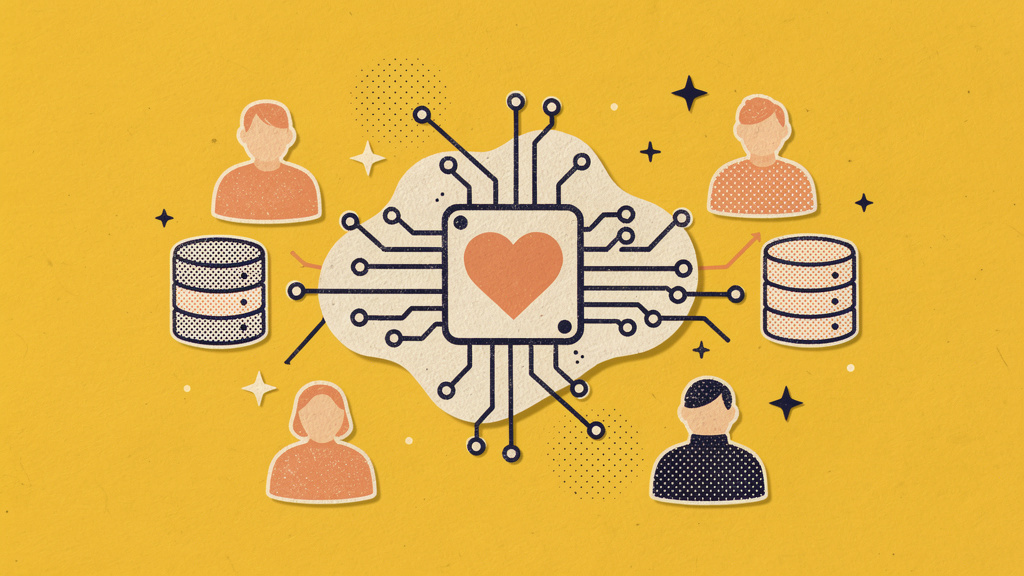
Okay, real talk: AI has officially jumped the shark in terms of buzzword saturation. It’s everywhere, promising everything, and if you’re leading a nonprofit, you’ve probably felt the pressure to “do something with AI” without a clear sense of what that actually means for your donor relationships. Sound familiar?
Here’s what we’ve found after working with nonprofits of all shapes and sizes: the gap isn’t about access to AI tools. It’s about knowing exactly where to plug them into your donor management workflow so they do something useful. So let’s dig into that together. In this post, we’re walking through how to use AI inside your donor CRM in ways that are practical, human-centered, and genuinely worth your time.
Start With Your Data, Not the Technology
Before you touch a single AI feature, audit your CRM data. Seriously. AI is only as smart as what you feed it, and duplicate records, missing email addresses, and inconsistent gift tracking will produce garbage outputs regardless of how sophisticated your tool is. It’s a little like asking someone to make you a great meal with spoiled ingredients. Not gonna happen.
A practical starting checklist:
- remove duplicate donor profiles and merge records,
- fill in missing data fields like engagement history, communication preferences, and giving frequency,
- standardize naming conventions across campaigns and funds.
Once your data is clean, pick one AI feature to test first, not five. A good entry point is auto-generated donor summaries, which give your team a quick snapshot of each supporter before outreach. Platforms like Funraise centralize donor profiles, donations, and engagement behavior in one place, making this kind of AI-readiness much easier to achieve without juggling multiple tools.
Protip: Block 30 minutes before your next board meeting to review AI-generated donor summaries. It’s a fast way to spot patterns your team might have missed and arrive better prepared.
AI-Powered Donor Segmentation: From Static Lists to Living Segments
Traditional segmentation puts donors into buckets by gift size or location and leaves them there. AI-powered segmentation works differently. It clusters donors by predicted behavior, engagement score, and lapse risk, and it updates those groups in real time.
| Traditional Segmentation | AI-Powered Segmentation |
|---|---|
| Sorted by gift size or location | Sorted by predicted lapse risk and engagement score (LiveImpact) |
| Static lists updated manually | Real-time updates from email opens and volunteer activity |
| Broad appeals sent to everyone | Tailored messages with up to 16% retention lift |
| Manual tagging by staff | Auto-tagging with a reported 23% lift in conversions |
Funraise’s Fundraising Intelligence applies this kind of behavioral clustering to help small teams identify high-potential donor groups without building complex spreadsheets. For a two-person development team, that’s not a nice-to-have. That’s a genuine lifeline.
Predicting Who’s About to Lapse (Before It Happens)
One of the highest-value things AI can do inside your donor CRM is flag lapse risk before it becomes lapse reality. Instead of reacting when someone stops giving, the system catches the warning signs early: declining email open rates, missed events, longer gaps between gifts.
Here’s how a practical lapse-prevention workflow looks:
- AI scans behavioral signals like no-shows, quiet periods, and reduced engagement,
- donors receive a risk score that your team can filter and prioritize,
- automated re-engagement sequences trigger with personalized references to past gifts,
- staff time is redirected to the highest-risk, highest-value relationships.
Nonprofits using AI for stewardship workflows report saving around 18 hours per month on manual list-building alone. And with overall donor retention sitting at 40.1% in 2023 industry-wide (Funraise), proactive AI intervention starts to feel less like a luxury and more like a strategic necessity.
Organizations using Funraise’s Fundraising Intelligence report 12% higher donor retention than non-users (Funraise, 2024 data), which is a meaningful difference when you’re trying to sustain programs year over year.
A Ready-to-Use AI Prompt for Your Donor Re-Engagement Strategy
Copy this prompt and paste it into whatever AI tool you use daily. ChatGPT, Claude, Gemini, Perplexity, whatever’s open in your browser right now:
You are a nonprofit fundraising strategist helping a development team re-engage lapsed donors. Our organization is [ORGANIZATION NAME] and we focus on [MISSION IN ONE SENTENCE]. We have a group of donors who gave [TIME PERIOD] ago and haven't donated since. Our average gift size is [AVERAGE GIFT AMOUNT]. Write 3 re-engagement email drafts: one warm and personal, one impact-focused, and one with a specific ask tied to an upcoming campaign. Each email should reference the donor's previous commitment and use a tone that feels human, not automated. Also suggest what data points inside a donor CRM (like giving history, engagement score, or last touchpoint) we should pull before sending to make these emails more relevant.
The prompt deliberately asks about CRM data points because that’s where the real personalization lives. If you’re using an all-in-one platform like Funraise, those data points, including giving history, engagement scores, and communication preferences, are already in one place. So turning the AI output into actual action is much faster than copy-pasting across five tabs.
And that’s worth naming: in our experience, the biggest friction isn’t generating good AI content. It’s the gap between that content and the systems where you actually do your work. Tools that have AI built directly into the workflow, rather than bolted on as an afterthought, tend to make that gap disappear.
When AI Helps You Write Donor Communications (And When It Doesn’t)
Generative AI can draft thank-you notes, campaign appeals, and SMS messages at scale. Funraise’s AppealAI, for example, generates peer-to-peer texts and emails with adjustable tones like urgent, friendly, or conversational, pulling from campaign context to give the copy a solid starting point.
Where this works well:
- first drafts of appeal emails during high-volume campaigns,
- donor thank-you variations across multiple segments,
- SMS copy for peer-to-peer fundraisers who need talking points fast.
Where you still need a human:
- anything going to major donors or long-term supporters,
- communications around sensitive program topics,
- any message where your organization’s specific voice matters most.
Protip: Always A/B test two AI-generated drafts against each other before rolling out to your full list. The difference in open rates will teach you more about your audience than almost anything else.
“AI doesn’t replace the relationship between a donor and a cause – it clears away the operational clutter so that relationship can actually breathe.”
Funraise CEO Justin Wheeler
Real Struggles We See Every Day (Sound Familiar?)
These aren’t hypothetical. These are patterns that show up regularly among nonprofit leaders before they get their AI-CRM setup working.
“We’re sending the same email to everyone because we don’t have time to segment.” The result is declining open rates and donors who feel like a number, not a supporter. AI segmentation solves this without adding hours to your week.
“We found out a major donor lapsed six months ago when they showed up at our gala.” No system was flagging the silence. No one knew to reach out. A basic lapse-scoring setup would have caught this in week two.
“Our data is technically in the CRM but nobody trusts it.” Duplicate records, missing fields, and inconsistent entry mean the AI outputs are unreliable, so the team ignores them entirely. This is a data hygiene problem masquerading as a technology problem.
If any of these hit close to home, you’re not alone, and the fix usually starts with a platform that makes clean data the default, not the exception.
Choosing an AI-Enabled Donor CRM That Fits Your Team
For small and mid-size nonprofits especially, the goal is fewer tools doing more, not a sprawling tech stack that requires its own project manager. Here’s a simplified comparison to help you think it through:
| CRM | Best For | Key AI Features |
|---|---|---|
| Funraise | Small to mid-size nonprofits | AppealAI, Fundraising Intelligence, donor insights |
| Salesforce Nonprofit Cloud | Large organizations with IT support | AI summaries, proposal generation |
| LiveImpact | Teams prioritizing segmentation | Predictive scoring, real-time segment updates |
| StratusLIVE | Microsoft-ecosystem organizations | Engagement scoring, enterprise integrations |
Funraise tends to stand out for teams that need fundraising and CRM in the same place without enterprise-level complexity or pricing. Users of Funraise’s Intelligence features raise 7x more online annually compared to baseline (Funraise, 2024), and there’s a free tier to start with, so you can test the workflow before committing to anything.
AI in your donor CRM isn’t a moonshot project. It’s a series of practical decisions: clean your data, pick one feature, review what it surfaces, and iterate. The nonprofits seeing real results aren’t necessarily the ones with the biggest budgets. They’re the ones being intentional about where AI touches their donor relationships. Start small. Stay human. Let the technology handle the patterns so your team can handle the people.
About the Author

Top Bloomerang Alternatives for Nonprofits That Need Marketing Muscle, Not Just a Database
Bloomerang is a strong donor database. If you are the one running campaigns, here are the alternatives that let you market without exporting a CSV every week.
The Rise of AI Agents in Ethical Mission Outreach: 2027 Predictions
What's Already Happening: AI in Nonprofit Outreach Today AI isn't some far-off concept for nonprofits. It's already driving real results. Organizations using AI-powered CRMs are getting a clearer, more complete view of donor behavior across channels, and that visibility is improving retention through predictive scoring. Tools like Funraise AI are already generating peer-to-peer appeals, personalized…
ChatGPT vs. Claude for Nonprofit Copywriting: 2026 Comparison
If you're running a nonprofit with a small team and an even smaller budget, you already know the feeling: there's never quite enough time, and copywriting somehow always ends up at the bottom of the list. AI writing tools have become a genuine lifeline for organizations like yours, helping squeeze more out of every hour…